As an Amazon Associate I earn from qualifying purchases. This post contains affiliate links.
If you grew up with a Game Boy Advance in your hands, chances are Pokémon was part of that story. The GBA era gave us five mainline Pokémon titles — Ruby, Sapphire, Emerald, FireRed, and LeafGreen — and today these cartridges are some of the most collected retro games in the world. Whether you’re a nostalgic collector hunting down a complete set, a player looking to relive the Hoenn and Kanto regions, or a reseller trying to understand what actually moves in this market, this guide breaks down every GBA Pokémon game so you know exactly what you’re buying.
We’ll cover the differences between each title, how rare and valuable they are today, what to look for when buying authentic Japanese or US cartridges, and which version is the right pick depending on your goals.
Check current prices: Pokémon Ruby (GBA cartridge) | Pokémon Sapphire (GBA) | Pokémon Emerald (GBA, Complete in Box) | Pokémon FireRed (GBA, Complete in Box) | Pokémon LeafGreen (GBA cartridge)
- Why GBA-Era Pokémon Games Still Matter
- Quick Comparison Table
- Pokémon Ruby & Sapphire: Where Hoenn Began
- Pokémon Emerald: The Fan-Favorite Third Version
- Pokémon FireRed & LeafGreen: Kanto Reborn
- Japanese vs. US Cartridges: What Collectors Should Know
- Condition Guide: What Actually Affects Price
- Which GBA Pokémon Game Should You Buy?
- Where to Buy GBA Pokémon Cartridges
- Frequently Asked Questions
- Final Thoughts
Why GBA-Era Pokémon Games Still Matter
The Game Boy Advance generation (2002–2005 in the West) sits at a sweet spot in Pokémon history. It was the last mainline era before the series moved to the Nintendo DS, and it introduced Hoenn — a region that split the fanbase but is now beloved by collectors for its distinct art style, double battles, and the Ruby/Sapphire/Emerald trilogy structure. FireRed and LeafGreen, meanwhile, remade the original Kanto games (Red and Green) with GBA-era graphics, making them a bridge between generations for collectors who want both nostalgia and playability.
Because these cartridges are two decades old, supply is shrinking every year. Internal clock batteries are running dry on the Hoenn games, plastic yellows with age, and complete-in-box copies are becoming genuinely scarce — all of which drives collector demand.
Quick Comparison Table
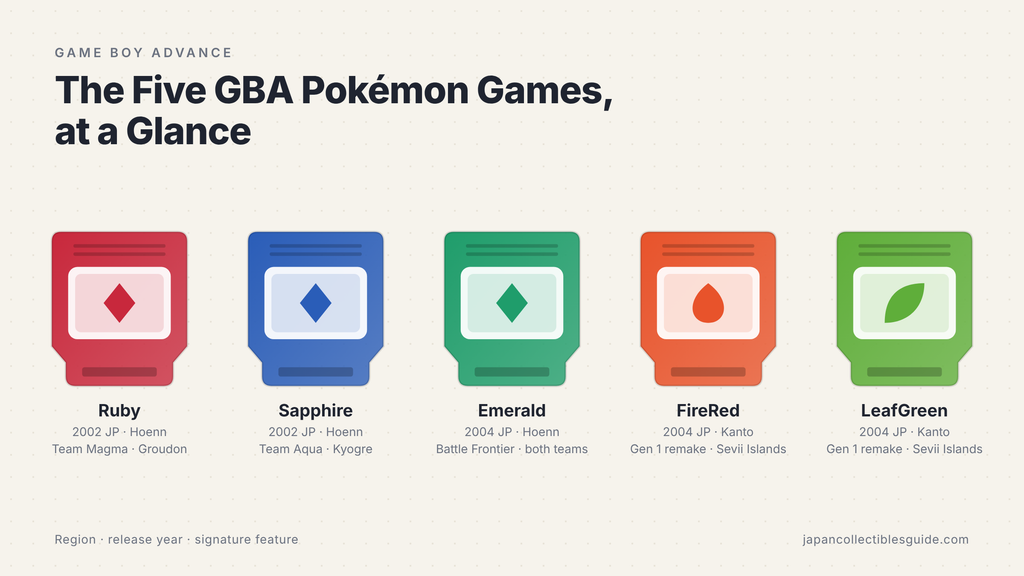
| Game | Release Year (JP) | Release Year (US) | Region | Notable Feature |
|---|---|---|---|---|
| Pokémon Ruby | 2002 | 2003 | Hoenn | Team Magma, Groudon |
| Pokémon Sapphire | 2002 | 2003 | Hoenn | Team Aqua, Kyogre |
| Pokémon Emerald | 2004 | 2005 | Hoenn | Battle Frontier, both teams |
| Pokémon FireRed | 2004 | 2004 | Kanto (remake) | Sevii Islands, Gen 1 remake |
| Pokémon LeafGreen | 2004 | 2004 | Kanto (remake) | Sevii Islands, Gen 1 remake |
Pokémon Ruby & Sapphire: Where Hoenn Began
Ruby and Sapphire were the first Pokémon titles built from the ground up for the Game Boy Advance, and it shows. The jump from the muted greens of Gold and Silver to Hoenn’s saturated tropical color palette was a genuine visual leap. Mechanically, these games introduced Abilities, Natures, and double battles — systems that are still core to Pokémon today.
Collector-wise, Ruby and Sapphire are the entry point into the GBA set. They’re the most commonly found of the five games, which keeps loose-cartridge prices relatively accessible compared to FireRed and LeafGreen. That said, complete-in-box copies with the original manual and box insert are increasingly hard to find in good condition, and prices for CIB copies have climbed steadily over the past several years.
If you’re a collector building a set on a budget, Ruby and Sapphire are usually the cheapest entry, but don’t assume “common” means “cheap forever” — the entire GBA generation has seen consistent price appreciation.
Pokémon Emerald: The Fan-Favorite Third Version
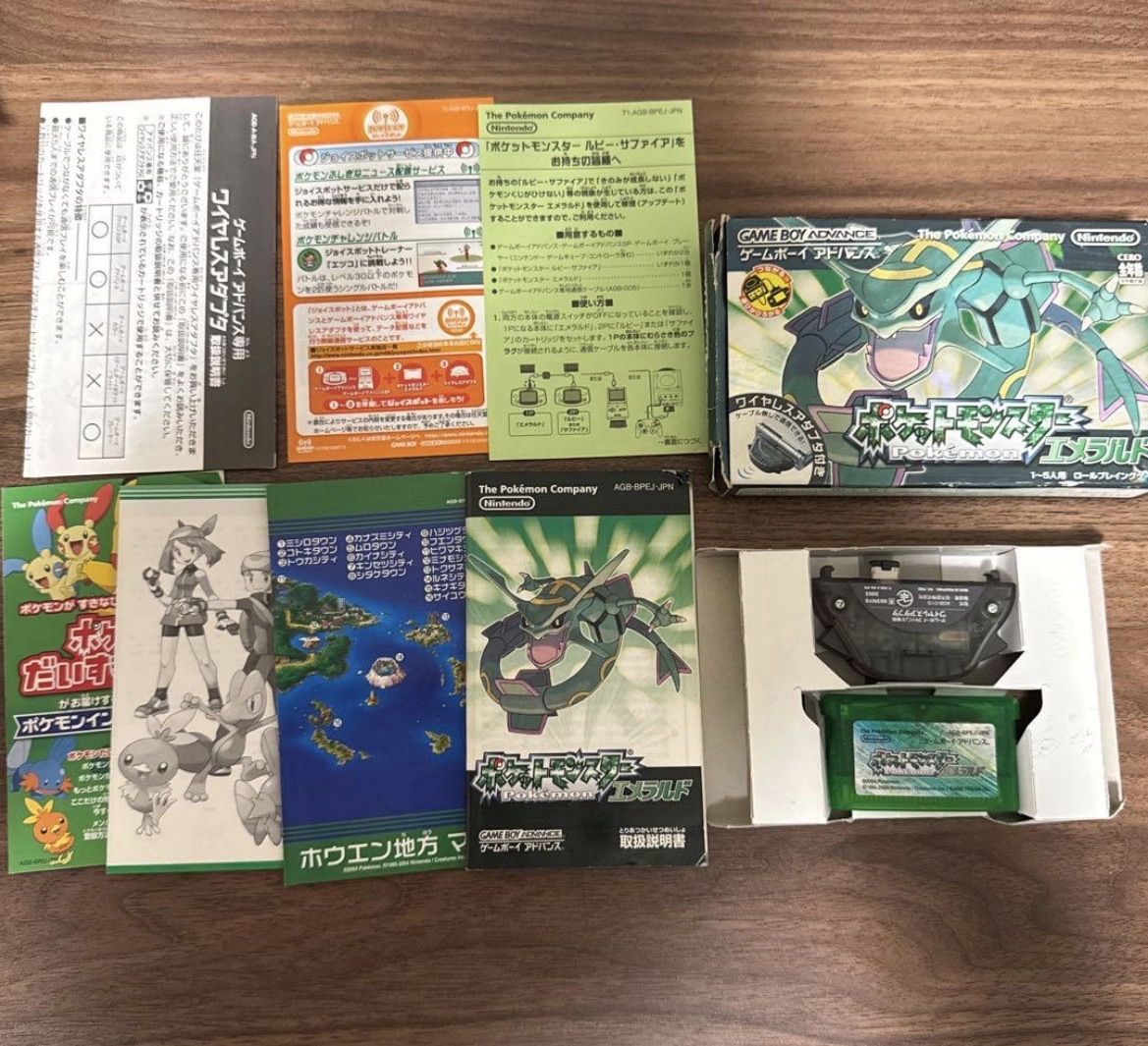
Emerald is widely considered the definitive Hoenn experience, and it’s often the most requested version among collectors and players alike. It combined the storylines of both Team Magma and Team Aqua, added the post-game Battle Frontier (a series of high-difficulty battle facilities that replaced the simpler Battle Tower), and let players catch Groudon, Kyogre, and Rayquaza in a single cartridge.
Because Emerald was a later release and is generally considered the “best” version to actually play, demand from both collectors and players is higher relative to supply. This makes Emerald consistently one of the more expensive GBA Pokémon titles on the secondhand market, often commanding a noticeable premium over Ruby or Sapphire even in similar condition.
For buyers: if you can only afford one Hoenn game and want the fullest experience, Emerald is usually the recommended pick — just expect to pay more for it.
Pokémon FireRed & LeafGreen: Kanto Reborn
FireRed and LeafGreen are remakes of the original 1996 Red and Green games, rebuilt with GBA-era graphics, updated mechanics from the Hoenn games, and an entirely new post-game area (the Sevii Islands) that wasn’t part of the originals. For many collectors, these two are considered the most desirable of the five GBA titles — they combine the nostalgia of the original 151 Pokémon with modern-for-their-time quality-of-life features.
This desirability shows up directly in pricing. FireRed and LeafGreen typically sell for noticeably more than Ruby and Sapphire, and often rival Emerald, both as loose cartridges and especially in complete-in-box condition. Japanese versions in particular — where they were released as part of a broader “Pokémon 3rd generation remake” push — can command strong prices when authenticated and in good cosmetic condition.
If you’re building a collection with resale value in mind, FireRed and LeafGreen are generally seen as the strongest long-term holds within the GBA lineup.
Japanese vs. US Cartridges: What Collectors Should Know
A recurring question for international buyers is whether to pursue Japanese or US (NTSC) versions of these games. A few practical points:
- Region compatibility: GBA cartridges are not region-locked in the way later Nintendo systems are, so a Japanese cartridge will physically play on a US or European Game Boy Advance console. Language, however, will remain Japanese unless the cartridge has translation options (none of these five do).
- Collector value: Japanese-market copies, particularly in complete-in-box condition with the original box and inserts, often carry strong collector interest internationally, especially for buyers seeking authentic first-release Japanese packaging.
- Authentication: Because these games are old and valuable enough to attract reproductions, buying from established, reputable sellers with clear photos of the actual cartridge (not stock photos) is important. Look for correct label printing, authentic PCB boards if the cartridge is opened, and a seller who confirms the game loads and saves properly.
Condition Guide: What Actually Affects Price
When comparing listings, condition drives price far more than most buyers expect. Key factors:
- Label condition — fading, scratches, and stickers/residue significantly affect value, especially on Japanese cartridges where the label paper is thinner and more prone to wear.
- Saving and the clock battery — Ruby, Sapphire, and Emerald save to flash memory, so a dead battery will not erase your save. The small battery inside only powers the real-time clock, which drives berry growth, tides, and other time-based events. After 20+ years, many of these batteries are dead; the game still plays, but those events stop, and replacing the battery is a factor serious collectors weigh. FireRed and LeafGreen have no clock and no battery. On any of the five, a cartridge that won’t load or save is worth considerably less.
- Box and manual completeness — cartridge-only, boxed-only, and complete-in-box (CIB) are three very different price tiers. CIB with all original inserts commands the largest premium.
- Pin condition and cartridge shell — yellowing, cracks, or corroded pins reduce both functional and collector value.
Which GBA Pokémon Game Should You Buy?
- Just want to play through Hoenn once? Ruby or Sapphire — cheapest entry point, full core experience.
- Want the most complete Hoenn experience? Emerald — worth the premium for the Battle Frontier and combined storyline.
- Prioritizing nostalgia and long-term collector value? FireRed or LeafGreen — the remakes of the originals, consistently in high demand.
- Building a complete GBA Pokémon set? All five are essential, but budget accordingly — expect FireRed/LeafGreen and Emerald to cost more than Ruby/Sapphire.
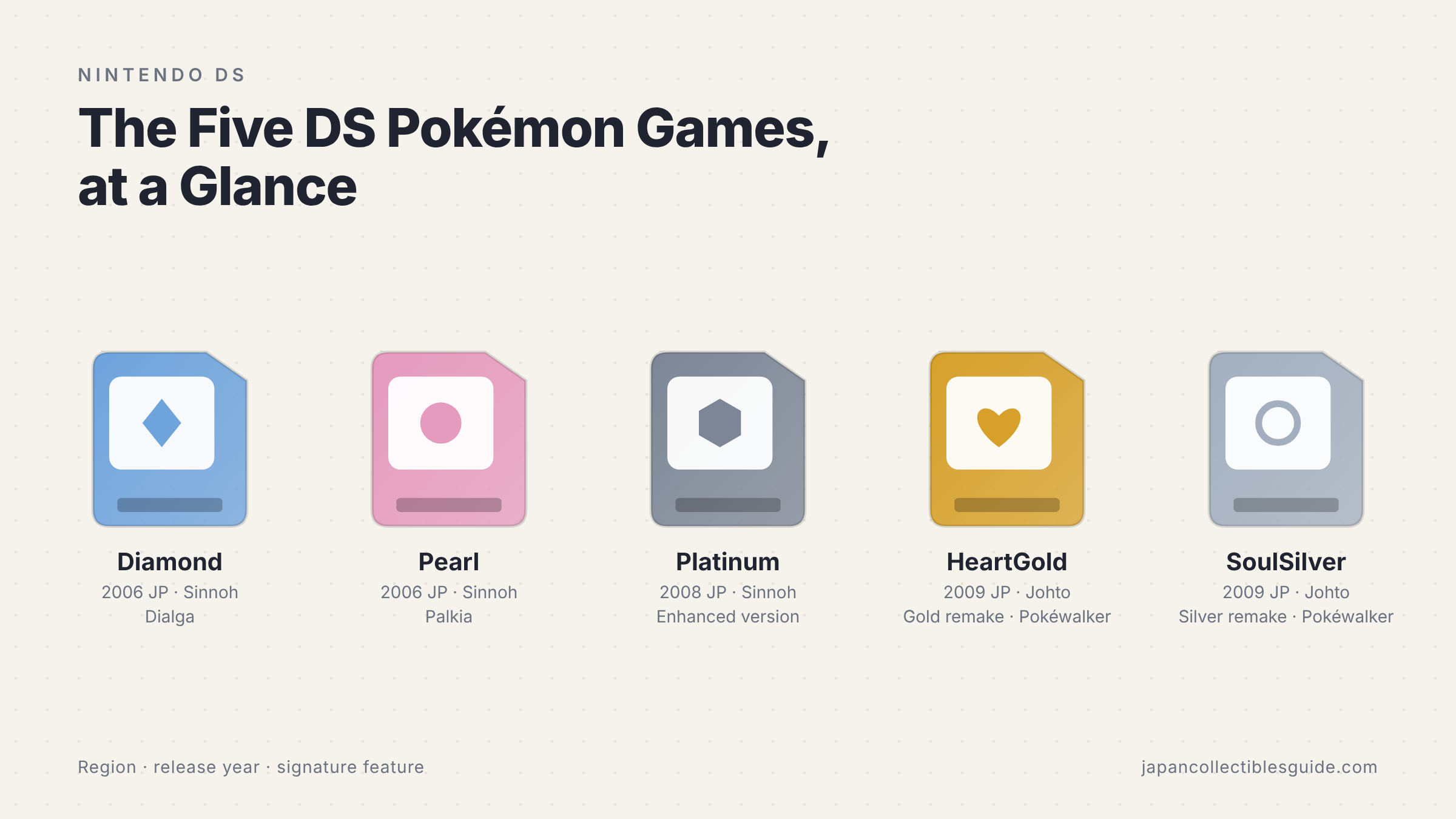
If you’re chasing the full handheld Pokémon lineage, our companion guide to the DS-era Pokémon games — Diamond, Pearl, Platinum, HeartGold, and SoulSilver — picks up right where this one leaves off.
Where to Buy GBA Pokémon Cartridges
Counterfeit cartridges have become more common as prices have risen across the whole retro Pokémon market, so check each listing before you buy: look for photos of the actual cartridge, read the seller’s reviews, and confirm the return policy.
- Pokémon Ruby (GBA cartridge)
- Pokémon Sapphire (GBA)
- Pokémon Emerald (GBA, Complete in Box)
- Pokémon FireRed (GBA, Complete in Box)
- Pokémon LeafGreen (GBA cartridge)
Related guides: our GBA & DS accessories guide for chargers, cases, and cleaning, and our Nintendo 3DS Pokémon guide for the generation that follows the DS.
Frequently Asked Questions
Are GBA Pokémon games going up in value? Yes — like most retro game collecting categories, GBA-era Pokémon titles have seen steady price appreciation over the past several years, driven by shrinking supply and a growing collector base that grew up with these games.
Can I play Japanese GBA Pokémon cartridges on a US console? Yes, GBA cartridges are not region-locked, so a Japanese cartridge will run on any GBA, GBA SP, or Game Boy Micro regardless of where the console was sold.
Which GBA Pokémon game is the rarest? FireRed and LeafGreen are generally considered the most sought-after of the five in strong condition, though true “rarity” also depends on region, print run, and box/manual completeness.
Do I need to test the clock battery before buying? Ideally, yes, but only for Ruby, Sapphire, and Emerald, which have a battery-powered clock. A dead battery doesn’t stop the game from loading or saving, but time-based events won’t work, and it can affect collector value. FireRed and LeafGreen have no such battery. For every cartridge, reputable sellers confirm that it loads and saves before listing.
Final Thoughts
The GBA Pokémon lineup — Ruby, Sapphire, Emerald, FireRed, and LeafGreen — represents one of the most collected corners of retro gaming today. Each title has its own identity, its own collector demand curve, and its own place in Pokémon history. Whether you’re chasing nostalgia, building a complete set, or looking for a piece of gaming history that’s likely to keep appreciating, understanding these differences will help you buy smarter and avoid overpaying for the wrong version.
This article contains affiliate links. We may earn a commission on qualifying purchases at no extra cost to you. As an Amazon Associate I earn from qualifying purchases.
コメント